
What we measure for out here
Boardwalk Meander's newer family homes tend to share the same brief as The Wilds: open-plan kitchen-living areas onto the garden, and bedroom windows that need real dark and quiet more than they need decoration.
- Blockout roller blinds for bedrooms and media rooms — see roller blinds.
- Motorised living-area blinds for wide sliding-door runs onto the garden — see motorised blinds & automation.
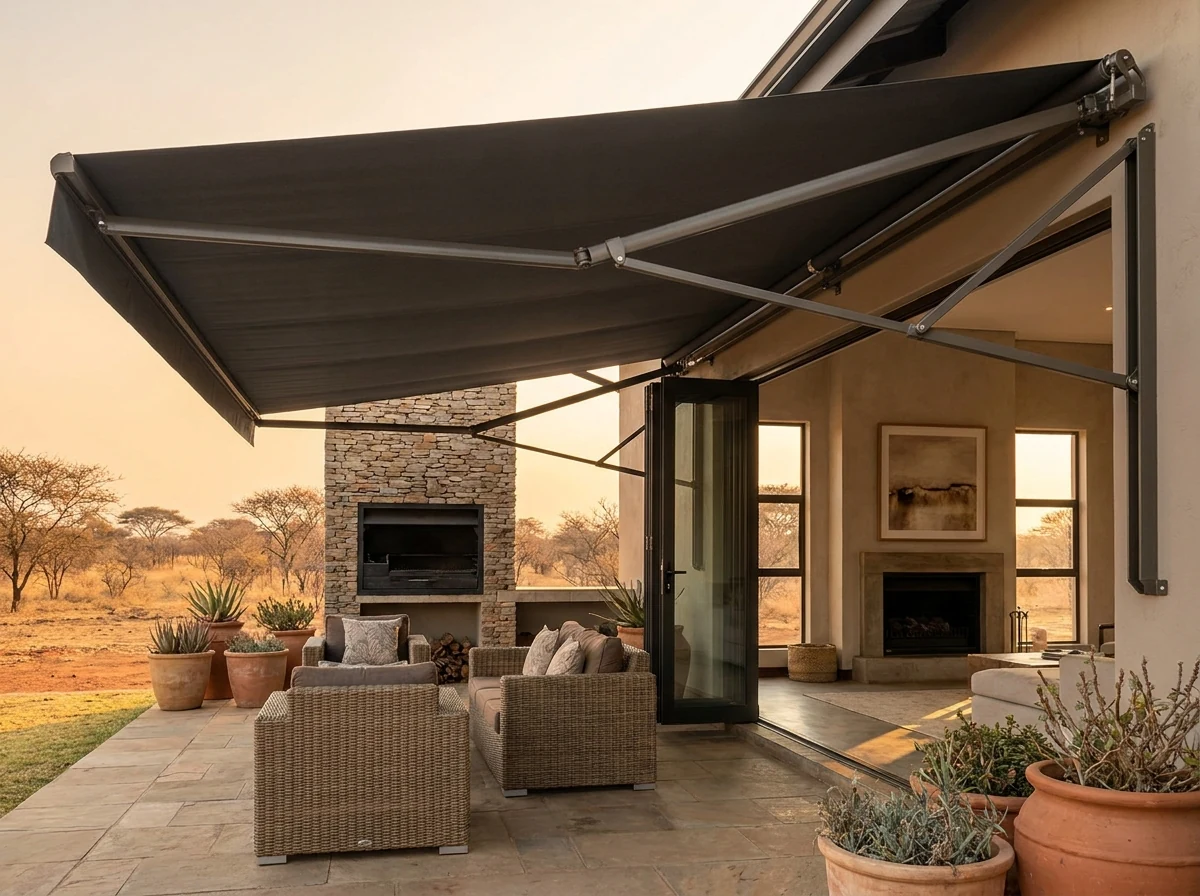
- Folding-arm awnings for the back patio, retractable so winter sun still gets through.
Because most homes here are recently built, we can often coordinate with wiring or ceiling work still underway — the earlier we're involved, the cleaner the finish, especially for motorised or concealed systems.
Making a bedroom genuinely dark
Most people who ask for blockout are disappointed by their first one, and the reason is always the same: the fabric was never the problem. A blockout cloth passes no light at all. What lets the morning in is the geometry around it — the few millimetres of clearance a roller needs each side of its brackets, and the line under the bottom rail. Fitted neatly inside a shallow reveal, a blockout will still leave a bright outline on the wall at six in the morning.
So the specification matters more than the fabric name. Face-fixed above the opening with sixty to a hundred millimetres of overlap onto the wall each side, a blockout roller makes a properly dim room. Add aluminium side channels and you get close to true blackout, which is what a media room or a shift worker’s bedroom actually needs. In a child’s room we would generally pair that with a cordless or motorised control so there is nothing hanging within reach of a cot, and every corded blind we fit carries a chain tensioner screwed into the wall as standard.
Getting to the house before the ceilings close
Where a home is still being finished, timing changes what is possible. If ceilings are open and the electrician has not signed off, a hardwired motor can be fed from above and the wall keypad set where you would naturally reach for it, with no visible cabling anywhere. A recessed head detail — a slot in the bulkhead that the blind drops out of, with the tube hidden entirely — is a bulkhead decision, not a blind decision, and it has to be agreed with whoever is building the ceiling.
None of that is a reason to rush. Rechargeable battery motors retrofit cleanly into a finished house and need no wiring at all, which is what most people here end up choosing, and a surface cassette hides a tube nearly as well as a bulkhead does. The only real cost of waiting is the wiring option, and we would rather set that out plainly at the measure than let you believe a finished house closes the door on automation. Whichever route you take, the written quote lists each window on its own line so you can see what the head detail on any one of them is actually costing.
Read the Wilds Light & Glass Field Guide — what the Highveld sun does to each elevation here through the year, and what we’d fit on it, with sources.